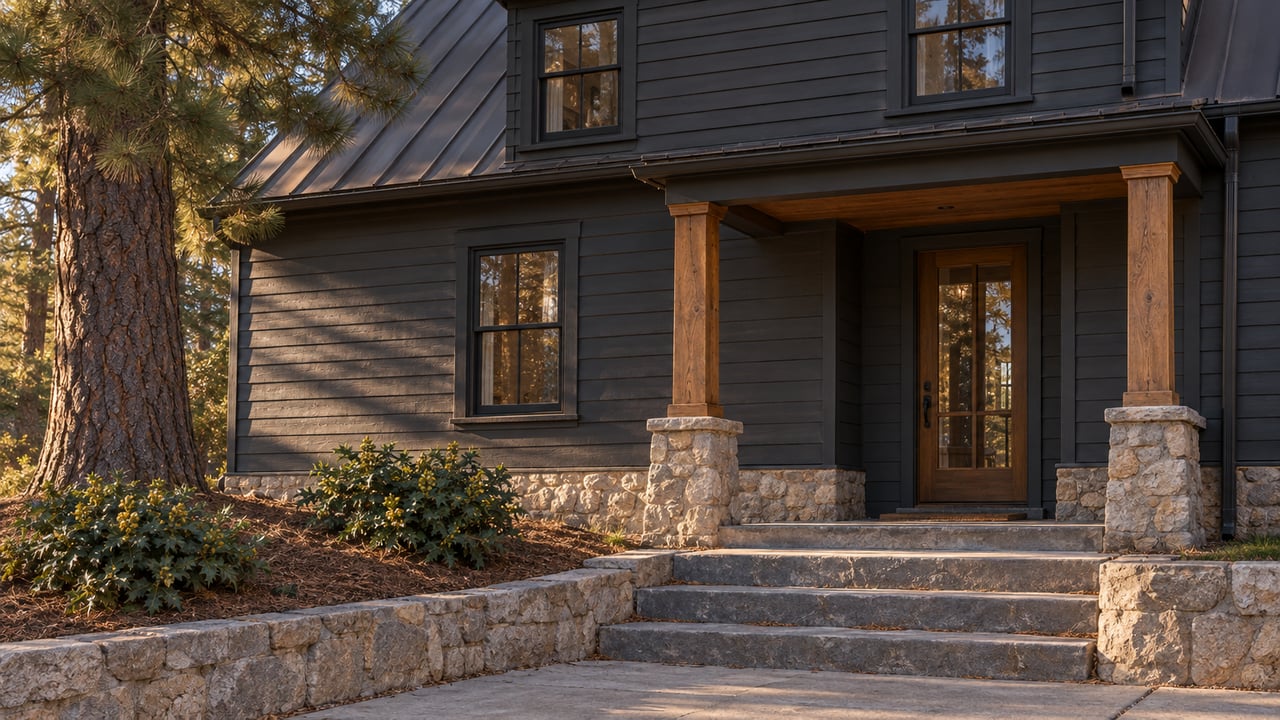
Picture two nearly identical restored Victorians a few blocks apart in Deadwood, both with the same gingerbread trim, the same steep pitched roofs, the same 1890s bones. One sits on a lot zoned Commercial Highway. The other sits in a Residential district. A buyer who wants to rent either one out short term will get two completely different answers from the city, and the difference has nothing to do with how old the house is, how well it has been restored, or whether it sits inside the National Historic Landmark District. It comes down to a line on a zoning map that most buyers never think to ask about until an offer is already in.
That gap between what a house looks like and what a house is legally allowed to do is the thing worth understanding before you write an offer on anything historic in Deadwood, whether you plan to live in it, rent it out, or eventually do both.
The Zoning Line Decides Before the Landmark Status Does
Deadwood's municipal code generally prohibits transient commercial use of residential property, with a fourteen day allowance each August, starting four days before the Sturgis Motorcycle Rally and ending three days after it.
The City of Deadwood restricts Specialty Resorts and Vacation Home Establishments, the category most buyers actually mean when they say "Airbnb," to Commercial and Commercial Highway zoning only. A house zoned Residential is not eligible for that permit at all, regardless of how the interior is set up or how the county assesses it.
Getting the Conditional Use Permit itself is not a one-time formality. An owner has to show proof of South Dakota state excise tax registration and a lodging license from the South Dakota Department of Health, and the city reviews the permit annually. This is a system built for ongoing compliance, not a box you check once at closing.
For a buyer comparing two similar houses, the practical takeaway is that the zoning designation matters more to a rental plan than the architecture does. A house can be listed on the National Register and still be flatly ineligible for a vacation rental license if it sits on a residentially zoned parcel.
The Second Gate: What the Historic Preservation Commission Controls
Zoning determines whether you can rent the house short term. A separate system determines whether you can change anything about how it looks.
According to the City of Deadwood, Deadwood is designated a National Historic Landmark and listed on both the National and South Dakota Registers of Historic Places. Because of that status, any exterior change to a property within a locally-designated historic district needs a Certificate of Appropriateness from the Historic Preservation Commission before work can start. A change requiring a city building permit also needs approval from the commission: a Certificate of Appropriateness within the district, or a Project Approval outside it. Either way, the commission reviews the request against the Secretary of the Interior's Standards for Rehabilitation, along with Deadwood's own 1991 Downtown Design Guidelines and its 2005 Residential Neighborhood Design Guidelines.
This isn't a volunteer committee working from goodwill. Deadwood's Historic Preservation Office was created in 1989 as a direct result of the state's authorization of legalized gaming in the city, and net municipal proceeds from that gaming fund the preservation work today. That funding stream also flows the other direction, into homeowner assistance: paint grant programs, a siding program, a retaining wall grant program, and a wood windows and doors program, along with revolving loan funds for larger projects. According to the City of Deadwood, owner-occupied properties are generally eligible for grants, while non-owner-occupied properties fall under the loan programs instead. A buyer restoring a historic exterior in Deadwood is working inside a system that also has money attached to it, which is worth knowing before assuming every repair is an out-of-pocket cost.
Where the Two Systems Collide
The zoning rules and the preservation rules were built to solve different problems, and in Deadwood they run into each other at a specific, physical point: the bedroom window.
As South Dakota News Watch reported, state law requires every bedroom in a licensed vacation rental to have either an exterior door or a window large enough to serve as a fire escape, with specific minimum measurements. Historic Deadwood homes were often built with narrower window openings that predate that code, and swapping a window may require Historic Preservation Commission review, depending on the property's location and whether the work requires a city building permit. Kevin Kuchenbecker, who handles planning, zoning, and historic preservation for the city, said that, for work subject to the commission's review in a National Historic Landmark community, any exterior alteration "goes through a review process," no matter how small the change looks on paper.
That means a buyer who clears the zoning hurdle, secures a Conditional Use Permit, and sets out to bring a historic house up to state fire-safety code for licensing can still hit a wall at the window itself. The upgrade that state law requires and the exterior change that historic preservation regulates are, in some of these houses, the same piece of glass.
Enforcement Has Caught Up With the Ordinance
None of this is theoretical. According to the Deckard case study, Deadwood passed an updated short-term rental ordinance in 2023 and, facing the usual problem of limited visibility into what was actually being listed on Airbnb and Vrbo, brought in a third-party monitoring platform called Rentalscape to track live listings across major booking platforms and support enforcement with real booking and pricing data. The city has since reached full compliance from all permitted short-term rental operators. Whatever the exact mechanics, the message for a buyer is straightforward: an unpermitted rental in a residential zone is not a low-risk gray area anymore. It is a monitored one.
There is a second layer worth knowing about too, separate from city ordinance entirely. The Daily Globe reported that, in 2021, the South Dakota Supreme Court ruled 3-2 on a dispute involving a rental property near Deadwood, outside city limits, where neighbors argued a private housing covenant limiting the property to "residential" use should have blocked the owners from renting it out short term. The court sided with the rental owners.
Softer Prices Don't Change the Rental Math
Deadwood's home prices have cooled some in 2026. Median sale prices across the city were down roughly 4 percent year over year as of July 2026, and asking prices for homes on the market were lower as well over the same period. For a buyer eyeing a historic property as a future short-term rental, a lower price can look like an opening.
It isn't, at least not on its own. A discounted historic house in a Residential zone is still not eligible for a Vacation Home Establishment permit no matter what it sold for, and a discounted house in a Commercial Highway zone still has to clear the same Certificate of Appropriateness or Project Approval process before undertaking any exterior work that requires review. Price and rental eligibility move independently of each other in Deadwood. The zoning map doesn't discount with the market.
Before You Write an Offer
A few questions are worth answering before, not after, closing on a historic Deadwood property:
- What zoning district is the parcel in, and does that district allow the type of short-term rental you're planning?
- Is the property inside the locally-designated historic district, which requires a Certificate of Appropriateness for exterior work, or outside it, where a Project Approval is needed for work that requires a city building permit?
- If bedroom windows will need to be enlarged or replaced to meet state fire-safety code for a rental license, has that change already been discussed with the Historic Preservation Office?
- If the property sits outside city limits, does a private covenant address short-term rentals separately from anything the city controls?
- If you plan to restore the exterior regardless of rental plans, have you checked whether the property qualifies for the city's paint, siding, retaining wall, or window grant and loan programs?
A Few Direct Answers
Can I rent my Deadwood house on Airbnb during the Sturgis Motorcycle Rally even if it's zoned Residential? Yes, within a specific fourteen day window tied to the rally each August. Outside that window, the general prohibition on transient commercial use of residential property applies.
Does National Historic Landmark status mean I can't change anything about my house? No. It means exterior changes that require review go through a process, either a Certificate of Appropriateness or a Project Approval depending on where the property sits, and that process comes with real grant and loan programs attached, not just restrictions.
If a house is zoned Commercial Highway, is a short-term rental automatically approved? No. Commercial and Commercial Highway zoning makes a Specialty Resort or Vacation Home Establishment permit possible, but the owner still needs an approved Conditional Use Permit, state tax and lodging registrations, and annual review.
A historic address in Deadwood tells you a lot about a house. It doesn't tell you what you're allowed to do with it. That answer lives in the zoning map, the historic district boundary, and in some cases a covenant that was written before the city ever weighed in. If you're weighing a historic purchase in Deadwood against a rental plan, a renovation plan, or both, Jenni Sneesby can help you check which rules actually apply to the parcel you're looking at before you're locked into an offer.
This article is general information, not legal, tax or financial advice. Consult a qualified professional about your situation.